

Another year has passed, and I find myself reflecting not just on the last twelve months, but on my entire life. I can’t tell if I’m finally emerging from the postpartum blur that seems to have lasted more than two years, or if moving to a new country has made the past not smaller but put my past life under a magnifying glass. Or, maybe, approaching 40 might mean I’m nearing a midlife crisis, and I have to admit it: the Jon Hamm meme hits. Hard.
The day before Christmas Eve, I spoke with my surgeon, and I tearfully walked him through a decade of pain, two failed surgeries, and my unspoken fears that this one, too, won’t work, won’t be worth it, will cause me more pain and infinitely more problems. In the midst of my lament, he stopped me. He said I was focusing on the bad, entrenched in the past, letting it dictate my future, which was—or could be—something entirely different.
Now I can’t unhear it.
So instead of replaying the long reel of what didn’t work, what I missed out on, what I will forever regret or wonder about, turn over, blow on, rub as if to see anew, I’m turning over something closer. The recent past. The year that just ended. The moments that mattered, surprised me, stretched me, and—despite everything—got me here. Almost 40. In Escazu, Costa Rica. Writing this Substack now.
And, so, a look back at my 2025.
January
It is bitterly cold, dry cold, and the second day of the New Year, My sister, M, and I go into the city. I finally have a chance to style my Emerson Fry story print skirt—long and shirred, modal satin—with cowboy boots in off-white. We eat a lunch of chicken thighs over Caesar salads, walk through the Lincoln Center sipping champagne, and settle in for The Nutcracker. There is Clara and Mother Ginger, the King Rat. Watching the Waltz of the Snowflakes, I feel light and unmistakably happy. In a place I tried to live in and failed to live in twice, I feel a draw. I feel like I am home, or coming home.
A week later, back in Columbus, the farthest thing from home, T, M, Aoife, and I celebrate my thirty-ninth birthday. Or mark it. Maybe. There are no gifts or cards. Instead, a simple sushi dinner on Broadway, where Aoife runs into a table.
Contributing to my depression will be this return, to this city, followed by a slow work month, which makes me feel destabilized. I spend my days searching design and brand studios in consumer goods, cold-emailing potential partners, waiting for replies.
Though the quiet stretches like a shadow, there is some color this month.
Beauty and texture are now things Aoife cares about. She runs her hands over her dresses, plays in her basket of bows and birthday crowns, pulling out the felt and cloth, hues of all colors. She dresses Panda in a green bow, Minnie in red, she slips a tiered floral monstrosity over her pajamas and walks around with a botanical headband framing her face a little like Mikey’s older brother in The Goonies. I can’t help but picture her as a young Josh Brolin, cycling on too-small tricycle down a hill in Astoria, where The Goonies was filmed.
Mid-month, I undergo an endoscopy under general anesthesia. When I wake, the room feels cottoned. My doctor tells me there’s nothing to worry about: just esophagitis, just an esophageal ulcer. He orders a course of PPIs. I feel relieved it’s nothing worse.
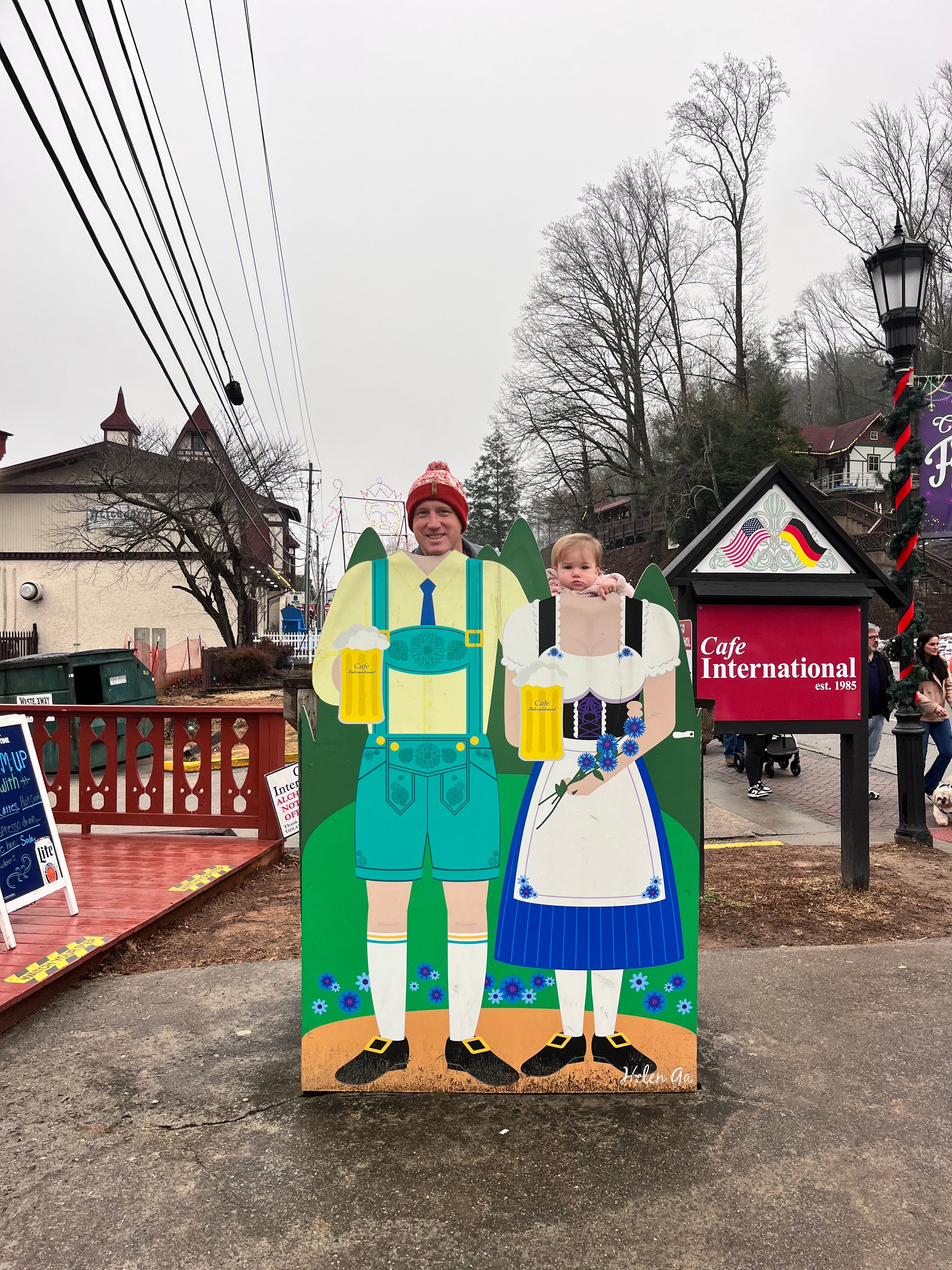
As if in celebration, Travis and I take a trip to the Georgia mountains, to Helen—a German-themed town. We eat Spätzle and schnitzel, potato pancakes, pickled carrots and beets. Aoife dances to 90s bands in one German restaurant, then plays on a human-sized chessboard at a beer garden. We visit a winery. One day it flurries. At night we soak in the farmhouse’s hot tub, eating licorice from the general store—dark cherry and watermelon pulled from glass jars
On our last days, we wake to the inauguration and news that the head of the Coast Guard—its first female commandant—has been fired. I feel sick, feel the shape of what’s coming.
February
I borrow The City and Its Uncertain Walls, Murakami’s latest novel in which a man enters a walled city where people live without shadows and strong emotions, separate from memory, desire, pain. On Apple TV, I watch Silo, a post-apocalyptic drama, where knowledge itself is dangerous. Relics—books and objects, ostensibly memory—are outlawed and, if found, destroyed. These feel like foreshadowing. Trump gutting the government, the new administration denouncing science, scholarship, reason.
I now am run by the clock, mete medications out in a way I never had to. A PPI in the morning, a PPI at night. At night, a glass of water, my Mirtazapine, then spooning globs of Gaviscon into my mouth. Aniseed flavored, it tastes like licorice. This month I go to Columbus’ St. Francis Hospital for a barium swallow study. I drink the chalky liquid that turns fluorescent when imaged and lay on a table as they move me up then down, right then left—Frankenstein coming alive. At the end, the radiologist tells me there are no visible signs of herniation. He tells me there is no visible ulcer. Healing is likely, he says. Likely is the word that stays.
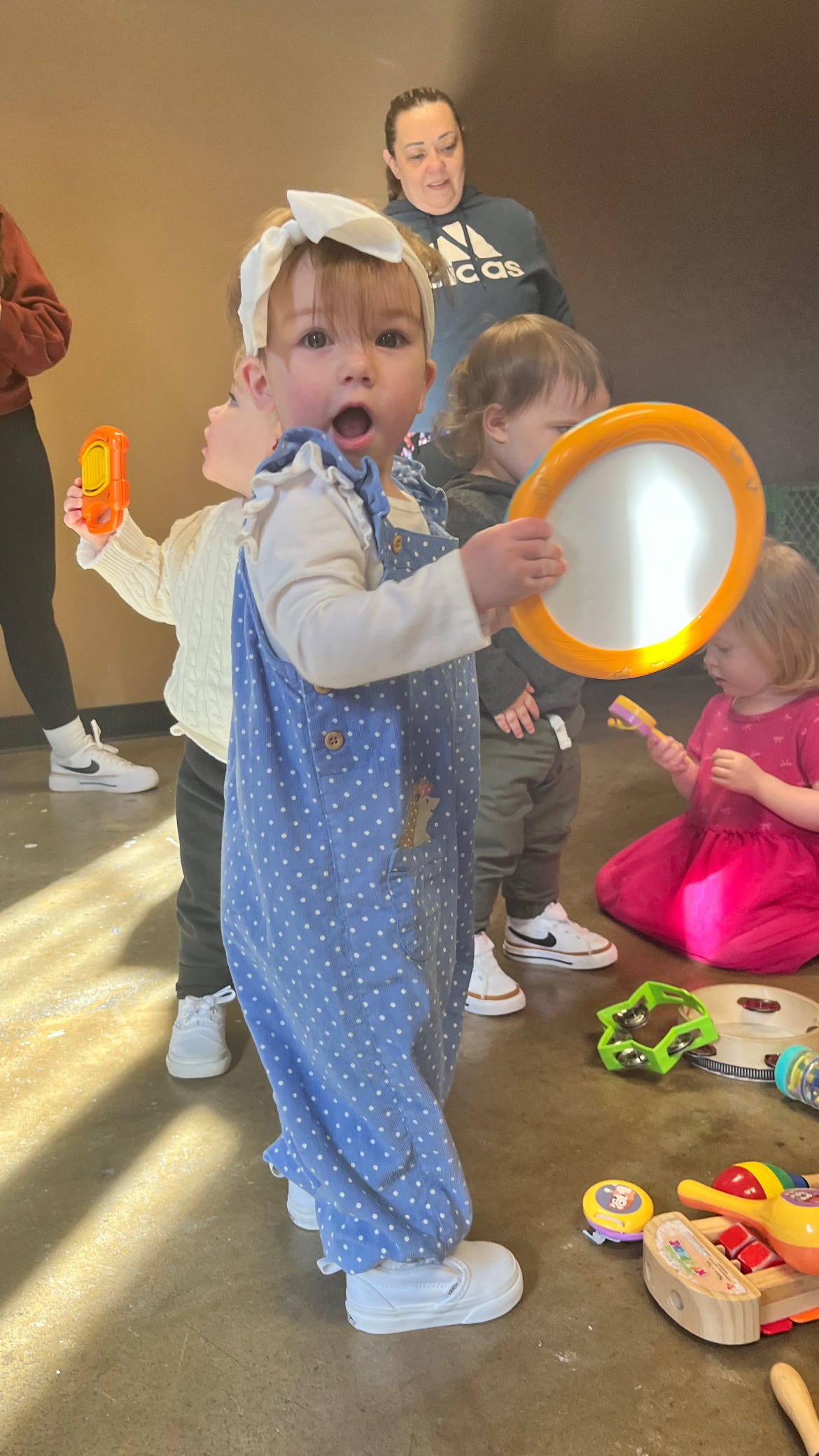
At home, work still slow, I follow Aoife and M to Zumbini classes, where we shake maracas when the instructor Jess shakes maracas, wave handkerchiefs when Jess waves handkerchiefs, dance to Beyoncé’s “Crazy in Love.” Afterward we walk to Fountain City Coffee for coffee and cranberry-walnut muffins.
Mid-month, T, Aoife, and I will travel to Illinois. Aoife, bundled in fleece and a hat, looks like Kevin McCallister. We visit her grandmother, from whom she steals an amber necklace. We visit her grandfather, with whom we eat Italian beef sandwiches—thinly sliced roast beef wet with jus and topped with sweet peppers. On Sunday, I visit Chicago and Francesca, whose book is coming out from blush. The city is freezing, yet I am thrilled to be in the presence of an adult human and dedicated writer, enjoying hummus, lightly dressed salad, and a basket of warm pita dappled in za’atar.
While in the Midwest, I hear that two working manuscripts, Full Bleed and The Areola Diaries, are named finalists for a prize and will be featured online. The Areola Diaries is also named a semifinalist elsewhere. Another note from a press says the work has promise. I let myself believe, briefly, that the work that carries me is worthy of print.
March
I receive an email from Granta announcing the start of the memoir workshop I had been accepted into and imagine a book about my first year of motherhood built from humor, catastrophe, and biblical plagues, with our Southern landlady cast as a recurring character, shiny veneers and all. I attend my follow-up GI appointment and hear that my Nissen Fundoplication has failed, my reflux is uncontrolled, my esophagus is damaged, and surgery is likely, with the word cancer hanging in the room longer than it should. I go home, take too much Klonopin, and cry. I keep moving anyway: I watch Severance for its clean lines and fluorescent calm, read I Am, I Am, I Am with growing unease, and take on naming projects that require just enough focus to keep me upright. I bike ferociously to the aphorisms of Cody Rigsby and Ally Love. I read Room on the Broom to Aoife until I can recite it from memory. I cook marinate chicken, dress arugula with lemon, grate fresh parm, fry potatoes, and eat too much arrachera bought from the Mexican supermarket, dipped in sriracha mayo. I go with M, T, and Aoife to a River Dragons hockey game, then go a second time, then a third, cheering on every fight. I try to read Priestdaddy and stop halfway through. I read all of Beautyland and decide this story of an alien-girl and a love story between mother, daugher is possibly the best book I’ve read in years. I bookmark my favorite quote. On Adina’s birthday, when her mother drives her to school, she says “Do you know…there are people who when they ride in cards, only ride in cars. They don’t point things out to make the other person laugh, they don’t joke or say anything…It wouldn’t occur to them. They sit there, driving in cars. Throughout every area of their lives.” I watch Aoife, like a car, tear through the Columbus Museum on children’s day, hoarding purple plush dolls, smashing food coloring into Cool Whip, dragging paint over bubble wrap. I use CapCut to make a video of Aoife dressing herself in layers of pajamas and overlay it with Little Edie’s voice: “This is the best thing to wear for the day, you understand.” Life peppered with dark and light.
April
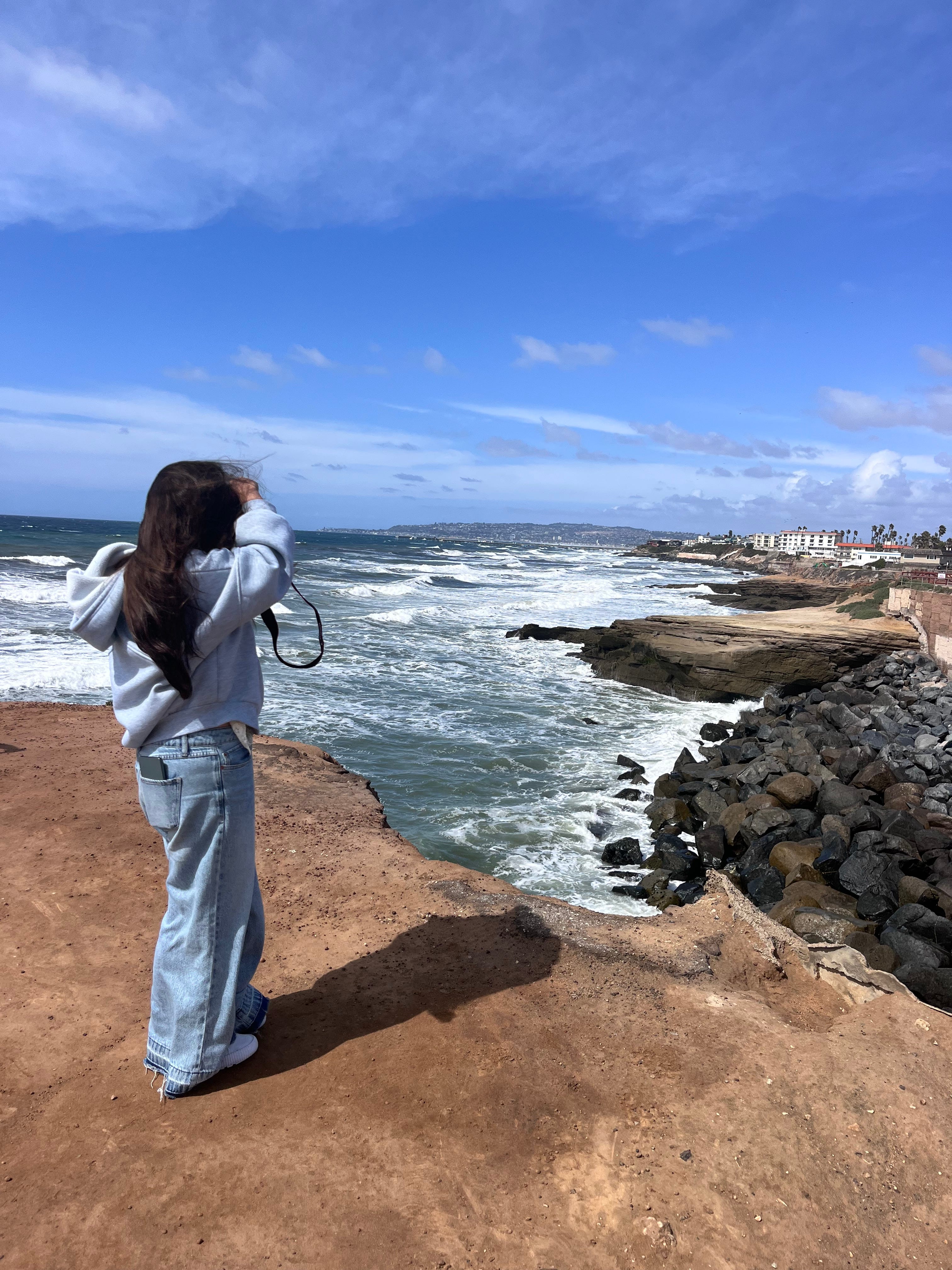
We chase the sunset all the way to the opposite coast, our family and M flying to San Diego for a week-long vacation and T’s cousin’s wedding. I feel at home. The air is cool, the sun hot. We stay in PB for half the week, then move to Balboa Park, which reminds me of San Francisco in its urbanity. Work has picked up and I’m juggling a large strategy project, naming several dermatology technology, and the naming of an oncology company, all at once. I try my best to create balance among calls, deadlines, and vacationing. I run to the ocean in the rain, eat fresh ceviche, drink craft beer. I take photos of pencil cactus and foxtail agave and California poppies—fluorescent orange in the sun. We take M, who has never been to California, to see the seals in La Jolla and to the San Diego Zoo, where we see elephants and red pandas, and where Aoife shouts “No! No! No!” when the hippos swim toward her, the bending of the light making the twinkle-toed beauties both larger and closer than they are. Here, in Balboa Park, I find a wine bar I dream of sneaking away to. I google their rotating menu too many times to count—chorizo deviled eggs, roast acorn squash, warm kale salad, feel drawn to their racks of pink and orange and yellow bottles. The wanting passes, but slowly.
M, Aoife, and I continue on to Connecticut. There we celebrate Easter, go to Westport for coffee and biscotti, wander through shops, and I visit my friend in New York who has recently lost her husband with M. On the train, M listens to music and I work on editing a manuscript. Before splitting off, we find ourselves in the midst of a protest outside the NY Public Library. While M explores Times Square, I have tea at the Mandarin Oriental with my friend and talk about the accident, about what we believe—or hope—exists beyond this, about children, love before and after loss. I tell her someone recommended The Telepathy Tapes to me, and we both agree we'll listen to them. The visit feels too short. I am sad to leave.
Back home in Columbus, I go in for another study to see how fast my stomach is moving, schedule additional testing. My parents will come down in May to help me make the drive in for my manometry, endoscopy, and Bravo placement. I am sad I have to do this all over again. I know I will cry in the hospital, and the tears will mean nothing and everything. This type of crying is hard to explain. It happens to me every big testing day, before every big procedure—whenever I am reminded I have sat here before: on a gurney, in a gown, warmed by anti-embolism socks, behind blue-and-white curtains.
May
A poem from The Areola Diaries is featured by the same press that selected it as a finalist, and within days, I learn that neither of my manuscripts will be chosen as winners. The news lands softly and insistently like a dull thud, just as I am going in for my endoscopy. I tell myself it doesn’t matter, that this writing doesn’t matter. But then ask what does: my illness? my child? my work?
My parents arrive for my study just as the air begins to warm, and my dad drives me to Piedmont Atlanta. There, I speak with the surgeon before the endoscopy and again afterward; he confirms that the ulcer has healed. To assess ongoing reflux, he places a Bravo chip. It is painful—tugging with each bite feels as though a giant conch has latched onto my chest. After a few days, we return the monitor I’ve been given, and while there, we stop at a children’s store. I buy a Mer St. Barth dress for Aoife and an armful of Great Pretenders bracelets. She breaks the smiley face bracelet immediately upon entering the car—flinging it like a slingshot, but the dress with pink tassels will become a favorite.
Back home and after weeks—maybe months—of not writing poems at all, I start again, taking a poetry workshop through blush on the New York School. I revisit Schuyler’s Payne Whitney poems, and am reminded that Peter posts “Sleep” every Valentine’s Day: “A paper lace doily on a small plate. Tangerines. A day in February: heart/shaped cookies...” I continue to work on my memoir. I listen to The Telepathy Tapes.
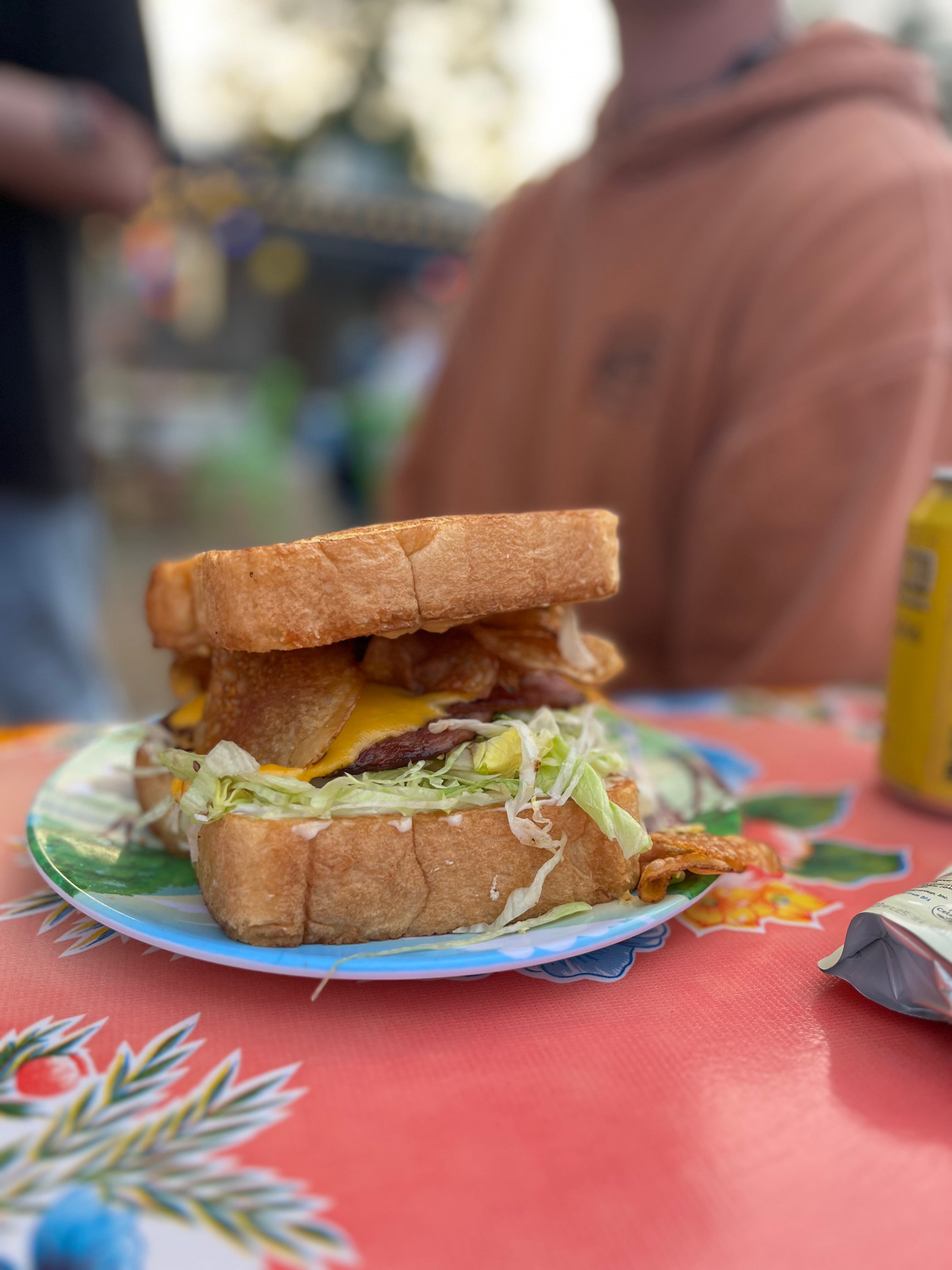
As May grows hotter in Columbus, we take more walks—to Broadway, to the Food Hall, to the playground, to outdoor concerts. A Journey cover band comes in from Atlanta, then a Nashville up-and-comer. On Memorial Day weekend, Travis and I take Aoife to Nashville to visit friends. She dances in a bar-restaurant to a blues band in blue gingham bell bottoms, then falls asleep at an outdoor concert after bouncing herself tired on red and yellow space hopper. She picks out a pink wooden push along pig toy, then scales a Coca-Cola–decaled cornhole board while we eat the famous bologna-hot mustard-potato chip sandwich at Turkey and the Wolf Ice House. At night’s end, she runs down their hill relatedly and we chase fireflies. Her eyes too small to catch them, it’s mostly me pointing at the unseeable.
We leave Nashville for Chattanooga, which is smaller, more mountain-like. Fog rolls in as we visit Lookout Mountain, and we get locked out of our Airbnb in town. Travis goes in search of the owner while I sit in the car with a sleeping baby in the heat. In that stillness, something cracks in me, and I am suddenly certain Travis has been murdered, or was never really with us in the first place. That reality itself has slipped. I call my parents “to talk,” without saying what I am afraid of: that I am alone with my baby, that I am scared I might hurt my baby, that I am scared this isn’t real, that I am simply scared.
June
I get approved for surgery, schedule it, and then get sick. The timing feels cruel, deliberate. I worry that SIBO has returned, question whether I’ve made the right decision to have surgery and commit to a twelve-day elemental diet that narrows my world to sticky sweet formula. I have only a few days after my diet’s end to say goodbye to Columbus and to M, who is leaving for a new family in Dallas, and the days collapse inward. We go to a Columbus Clingstones baseball game as a send-off, sit through the innings knowing the game is not the point. We find a home for Misha, our porch cat, and drink cosmopolitans on The Animal Farm’s back patio, the taste summery. Then we are gone. We say goodbye to M and drive to St. Simons through a thunderstorm that feels total, shopping for groceries to fill our rental in a downpour. Once settled, a rhythm takes over. Mornings are for swimming, Aoife planted in the surf ordering me or T or both of us to “Sit,” sand sticking to her legs. Early afternoons are for turkey sandwiches with hot honey and mustard and naps, late afternoons for the screened-in porch, cheese and crackers, and drawing with crayons on oversized paper as walkers and bikers pass. Evenings we eat Cajun shrimp at various restaurants, then beach comb. Kites fly, dogs bark, and darkness steeps, as Aoife kicks a Columbus Clingstones’ baseball and Louis Prima’s “Oh, Marie” drifts from somewhere unseen. I live in caftans and Palm Beach sandals and try to read Grief Is For People, feeling myself deflate over the pages, the language feeling distant, the death of Russel distant, too. When the vacation ends, I sit with a hard truth—I feel no better after my diet, and the worry about surgery hums beneath everything. We travel on—to Key West—to turn over our house. We wash carpets and bedding, push furniture to the walls so space opens in the middle. Robert, our longstanding handyman, arrives to lay linoleum over the damaged wood, puts his hand guns in our cupboard on our dinner plates for “safekeeping.” I work poolside on a healthcare project run by an old classmate, take evening calls for small naming jobs with long-standing colleagues on the patio, vines swinging hotly as dusk settles. The voices on the other end of emails and phone lines feel both far off, yet familiar. I recognize, slowly, that what I have been missing is not geography or permanence. It’s connection itself.
July
The sun continues to shine easily in the Keys. The pool is warm, the water aquamarine, and people smile without asking much in return. Bob waters his plants in a speedo and a thick gold chain—his curmudgeonly nature less curmudgeonly, while the neighbor's bulldog snuffles up to Aoife each time we pass. Roosters roam with their chicks and pullets; iguanas scatter through the undergrowth. Even the poincianas are unapologetically red.
With the house now mostly ready, we make time for breakfast sandwiches at Sandy's, for sunset watching on the USCGC Ingham, for boat rides and happy hour hunts—a bona fide sport for locals in the Keys. Steak tips and calamari, the famous cheesy bread at Boat House, hummus and pita and wine at Oasis, drinks and a view at Louie’s Backyard. Friends visit. We watch fireworks from Higgs Beach. Aoife cries at the first explosion, then dances as we pass a party spilling out from one of the gated Casa Marina homes. Each night, we fall asleep with our French Doors open, the palms swaying us into slumber. It’s hard to believe we’ll leave the island again. Harder still to believe we’re soon moving to Central America.
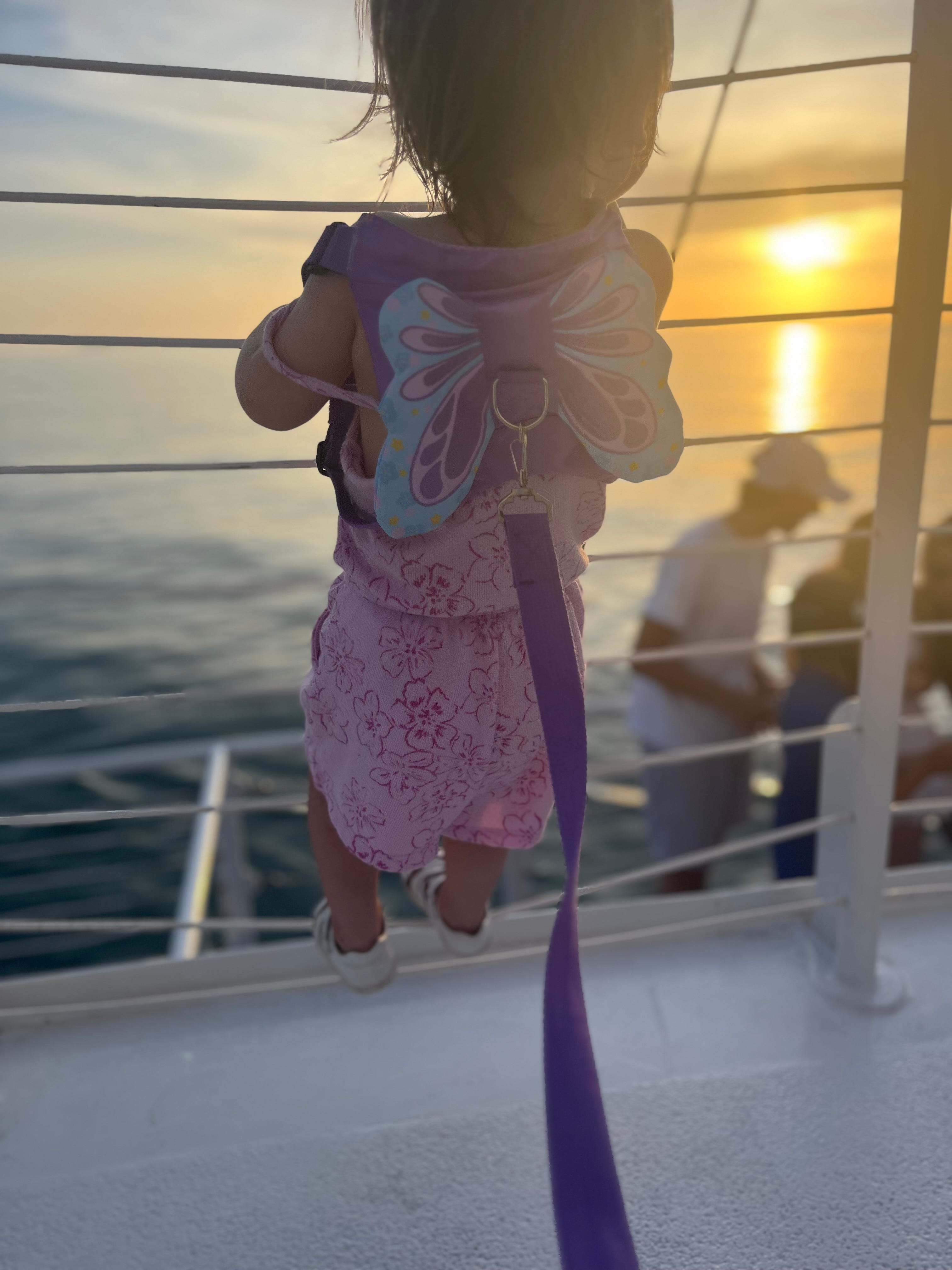
Back in New England, plans begin to unravel. I cancel surgery as I am unsure whether my body will cooperate and mine and Aoife’s departure for Costa Rica becomes uncertain. I want to have surgery before travel but am unsure I can. I don't know how my insurance works once I leave the US. I read that my anxiety medications are tightly controlled in Costa Rica. I need a note, or several. I don’t have a psychiatrist in our new country. My psychiatrist in this country proves impossible to reach. The uncertainties accumulates quietly, like pressure, and I imagine the days ticking by.
During this time, a lot happens. Travis travels to D.C. for training, and I embark on a semi-water fast, convinced I have SIBO, convinced discipline and near-starvation will succeed where formula has failed. For twelve days I drink only water, electrolytes, Perfect Amino supplements, Benfomax, calcium phosphate, potassium citrate. Instead of clarity, I develop a thumping in my chest, pain radiating down my arm. I can't sleep without medication and even with medication, I can't sleep. I go to the ER by ambulance. I go again by car. The EKGs are normal. I am told to see a cardiologist.
I stop my diet and still don’t feel well, but Traivs, Aoife, and I travel to Massachusetts, hoping to see friends in Newton and Cohasset. One visit falls through, but the other holds. In Newton, we take a day and go swimming at Crystal Lake, in the shadow of the green line. There we snack on our kids' Annie's cheddar bunnies, let them fight for other children's toys, pails, and balls. I dive off the dock. The water is cool and fresh. While on the shore, I read bits of Animals Eat Each Other. I envy the protagonist’s willingness to drift. How she lets Matt and Frankie dress her, direct her, touch her, feed her, tattoo her. How she relinquishes authorship of herself again and again. I think how I wish someone would just dress me up, put me on a leash, and demand I act on their commands in parking lot, superstore. So tired I am of holding tight to this semblance of control. So tired I am of making decisions.
August
Aoife and I are set to move, but I keep hedging.
I go to Northampton, see Jon and Juliana. A lot has changed. Haymarket is closed, as is The Roost—replaced by a pricey Jewish deli. Despite this, I sleep in the third story of a Victorian I once took photos of the week I moved to Massachusetts, drink an outrageously priced whiskey sour at an unrecognizable Green Room, take photos of the wildflowers in bloom, edit my memoir-in-progress.
I go to Mystic Aquarium with my parents and Aoife where we spy clownfish and blue tang and sting rays, and point and shout “Nemo!” “Dory!” “Mr. Ray!”
In Connecticut, I lie in bed and read Truth & Beauty, Ann Patchett’s intimate meditation on her friendship with the late Lucy Grealy. On Grealy’s illness and surgeries and subsequent addiction, and Ann’s devotion. I go to cardiologist for testing, only to find nothing is wrong with my heart—“esophageal spasms” is the conclusion that is drawn.
Charged, I call my insurance to better understand my coverage. Then I call them again. Then I get them to put it in writing. I call my psychiatrist and get a note. I email the embassy doctor and get a psychiatrist. I put my ducks in a row.
Nanny-less, Aoife is watching too many episodes of Minnie Bow-Toons far too often and has taken to lining up her toy figurines, amassing an enviable collection: Nemo and Kathy, the buck-toothed triggerfish, and Pearl, the pink octopus, a shark duck and unicorn duck and alien duck, a lime-green stegosaurus. In the afternoons my parents and I take her to Perfect Playdate! where she hides in tents, dresses in princess dresses, and steals pet-carrying cages from the child-sized veterinarian hospital. In the evenings, we blow bubbles from our porch, read The Gruffalo and We’re Going On A Bear Hunt, Llama Llama Red Pajama, Cave Baby, The Paper Dolls. Before we turn in, we hunt the moon, watch Sound of Music, Wizard of Oz, Mary Poppins.
As the summer draws to a close, I teach a workshop on commercial writing and poetry with The Subtext, see a poem published in Antiphony, and T and I solidify our plans for me and Aoife’s move to Costa Rica. I delight in shopping for our new home--Native shoes for rainy season, an army green rain slicker, crop tops of every color for the beach, Omika shorts and Haris Cotton linen for resort flair. I buy a pair of Intentionally Blank platform slides, and during my spree become obsessed lab-grown tennis bracelets, bracelets I do not purchase, cannot justify—do not need, and yet research obsessively. As our travel approaches, I tie up loose work ends—I am naming of a food testing company and an rPET technology, and fall asleep to a young Clare Danes and Jared Leto in denim and flannel in My So-Called Life.
September
I dive headlong into a workshop—Bad Mouth—with blush. The Bad Mouth readings makes me laugh and rekindle an attention I thought I’d lost. Vestrini’s parataxis, in particular, connects. I think about the space between actions and how it echoes the dissociative way I move through the world: I make an egg. I sing “Just keep swimming, just keep swimming.” I text a friend. I take an edible. I cry.
Travis flies to Connecticut to fly us to our new home, and I don’t know what to expect. I’ve flown into San José before and am surprised by the familiarity—the stuffed sloths and monkeys in the gift shop, the bags of Britt coffee. We drive twenty minutes in pitch dark and pull up to a gatehouse in the middle of the night.
Our things haven’t arrived yet, so we live on embassy-issued Ethan Allen furniture. I spend most days moving between the bedroom, where we’ve set up a desk for my work, and the living room—an indoor-outdoor space that opens onto a patio we turn into Aoife’s makeshift playroom. I meet D, who will be Aoife’s nanny before she starts school. I learn to use Google Translate. When people ask what Escazu is like, I say, It’s like America. There is a Costco (PriceSmart). The toilet paper can be flushed. You can drink the water. We have AC and reliable internet. Most people speak English. The one difference being everything is barred, wired, gated, locked. Armed guards patrolling private property, shopping malls, parking lots.
Newly arrived, I try to understand my role in the midst of turmoil. The bombings of the Palestinian people in Gaza continue. I watch from afar as borders harden and masked men take to the streets—apprehending innocent people. I see benefits thin out, food stamps rumored to soon be under threat. Then Kimmel is suddenly pulled from the air for criticizing the president, to universal outrage. This further complicates my role as a writer, as an American elsewhere, as a person that is part of a diplomatic household. At night, after Aoife sleeps, I read Molly Brodak’s Bandit, a book about a daughter circling the wreckage of a father’s life. The sentences keep returning to the same ground, as if there were no clean way out.
Around this time, I read a post from an old colleague and an investigative journalist:
“The worst part isn’t the public spectacle—it’s the quiet. The unsent email. The story pitch abandoned. The student who sits on their hands. Self-censorship is the victory condition for the speech police. You don’t need to arrest a population that has learned to muzzle itself. You just need to make a few examples and keep the rest of us flinching…Here’s the rallying cry, plain and actionable: Speak. Cite. Contextualize. Defend others’ right to do the same…The goal isn’t to make speech safe; it’s to make it free—and to make the cost of silencing higher than the cost of debate. Say the thing. The country you save might be your own.”
I feel a renewed sense of urgency.
October
At the turn of the month, Aoife starts at a Montessori School. When me and D pick her up, and I say “we’re leaving,” she gallops around the play yard in a circle like a tiny pony—ecstatic, happy, and wailing “Nooo!”
My parents come to Costa Rica for Aoife’s second birthday. While they’re in town, keeping watch over my little one who is now fully occupied by school, I fly west for The Business of Naming, a conference exclusively for namers. I’m not feeling well—my reflux flaring, but I ignore the pain and let myself enjoy the Bay, a place I miss more than I expect. Friday, I see a good college friend S and we eat a fixed-price meal at MAMA on Lake Merritt. Saturday, I stop at Snail Bar for pan con tomate, snails, and crudo in Temescal. Sunday, I see my old roommates, L and J, and their baby V in San Carlos. We share toddler war stories and Blue Line pizza, its cornmeal crust reminiscent of our old haunt Little Star and grounding me in a way I didn’t know I needed.
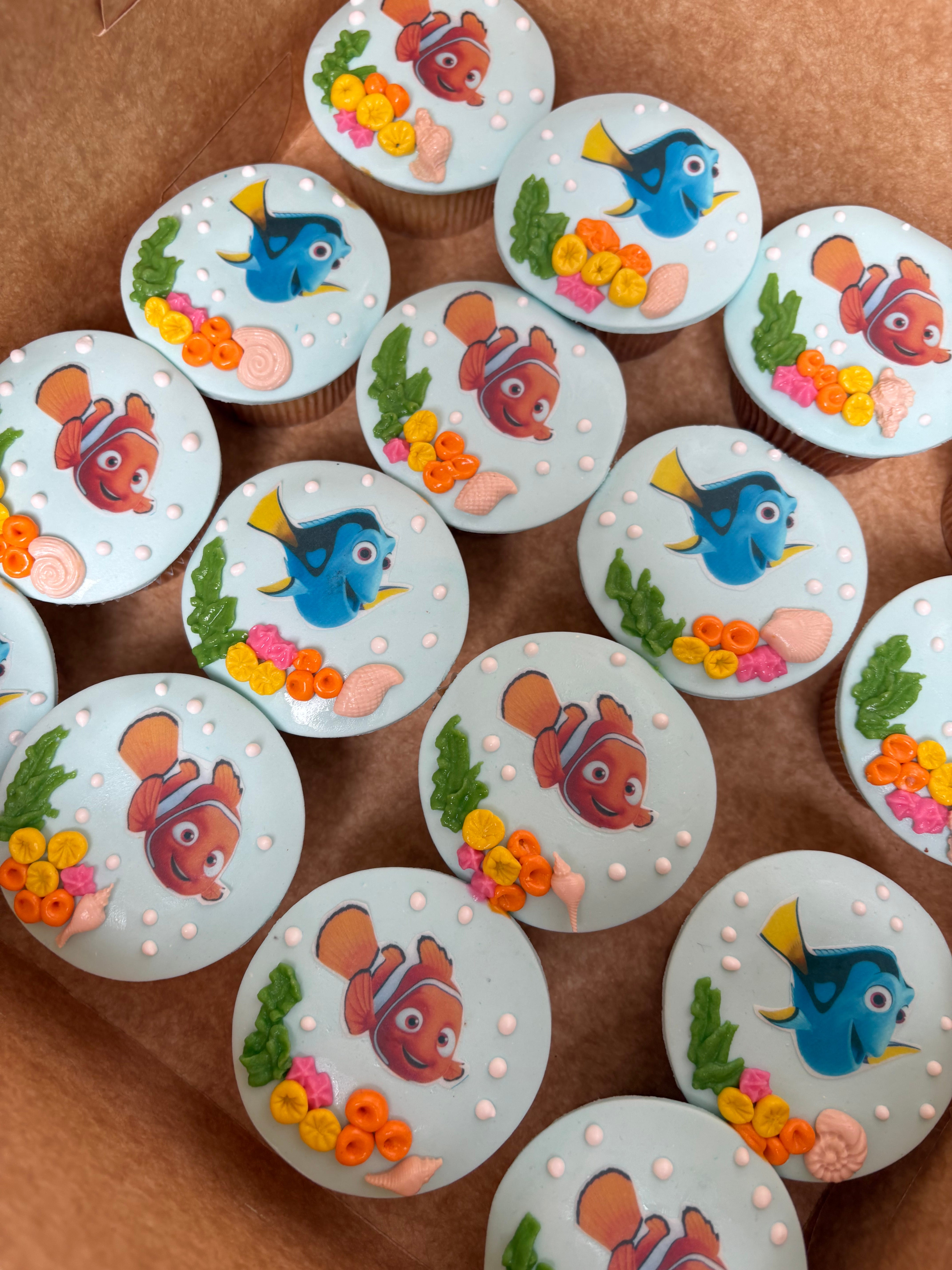
Back home, it’s Aoife’s birthday. We order a Nemo cake over WhatsApp from someone in San Rafael. It’s blue and aquamarine, topped with paper fish. She also makes cupcakes for Aoife’s class, a celebration we’re invited to attend. In front of a framed black-and-white photograph of Dr. Maria Montessori, we sing to Aoife who scream-cries in fear, especially when she’s asked by her principal to “circle” the room—another year in the sun.
Around this time I start work on an architecture project for a Fortune 500 company, and we finally begin to step outside Escazu.
We take a trip to Quepos, near Manuel Antonio, where we visit a hidden beach two days in a row. Here rain cuts a thin freshwater stream, bracelet-narrow, into the ocean, and monkeys leap overhead.
A week later, I finish Jenn Shapland’s Thin Skin, and we will visit Cowboy Country. We hike to waterfalls with friends, stay at an eco-lodge. At one waterfall pool, a guide borrows my phone to fake a drone shot of our group, our babies in their life vests. The footage is absurd. That night, over wine and steak, cassava, we laugh. It is good to see friends.
Back home, I start Zine Writing Club, a low-stakes workshop with incredible writers experimenting with form. The theme is Emo Geography. Having moved from California to Massachusetts to Oregon, Florida, Georgia, and now Costa Rica, I think maybe there’s something there for me. There is. But it’s not what I expected.
November
This month kicks off with a 14-day elemental diet. I lie in bed and supplement my formula with eggs, determined to kick SIBO once and for all. I read Lily King’s Heart The Lover, needing something easy when I feel so tired. I share out two of my poems published in Little Mirror from my bed. In bed, I fall in and out of sleep to The New Yorkers’ Blood Relatives. I continue my funny memoir—taking L.A. Warman’s The Wager, though I’m finding it hard to come to the page. Throughout the month, Emo Geography begins to clarify something I’ve been skirting: how far I’ve moved from myself. With each move, another concession. My illness making me softer and more malleable, agreeable for and to others, but less true to myself. Writing being sole constant, people from my past appearing like magnets in my thoughts and dreams, pulling me back into an older, truer self.
I’ll miss the last Emo Geography workshop in lieu of the blush 2025 catalog launch party in New York, which I decide to attend. when I fly, I am excited but ill. My period is exasperating my stomach issues, and my anxiety is impossibly bad. I worry about the MetroNorth ride into Grand Central, take a Klonopin. I panic on a crowded subway to Crown Heights and drink a can of wine. The next day, I nearly throw up on the way back from Chinatown, pork dumplings and stir-fry noodles in hand, then take Klonopin like candy at dinner at Shukette, unable to eat the hummus and frena, worried I’m allergic to an unknown spice, that I am going into—am experiencing (right now, here)—anaphylactic shock. Back at the hotel I feel safe, binge watching The Beast In Me. I realize this—bed rot—is what I asked for last year as I moved into 2025, but I didn’t realize how much I would miss in getting it. I miss my baby. I miss her little voice, learning—saying “Silly Minnie!” “Sad Minnie!” “Mad Minnie!” “Happy Minnie!’ “Surprise Minnie!” as she shakes out disembodied, wooden Minnie heads from a Melissa & Doug box.
I take a direct flight from JFK to San Jose and get home in time for Thanksgiving. My parents come in and we piece the meal together—canned cranberry from Connecticut, a Butterball turkey from PriceSmart, boxed stuffing I ordered weeks prior from Williams Sonoma. The next day we leave for Jacó and the beach. At night, we spot a crocodile behind a fence at our Airbnb. We watch the sun set, water and sky collapsing into a mirror, Aoife seeming to walk on clouds.
December
Work is slow, and I start stacking Peloton classes, taking long walks to hit my steps, consistently do arm exercises. I sign up for Sculpt Society and buy all the equipment: the pilates ball and hand weights, ankle weights, bands. I start and finish Mona Awad’s We Love You, Bunny—the attic of Murder Fairy haunts me, reminds me of an apartment in Hanover I once visited, and also a girl’s house in Georgetown—the past looming larger than ever.
I continue with LA’s The Wager and my memoir. I publish two poems in Luna Luna Magazine. Feeling better, I make the decision to have surgery, setting up a final call with my surgeon—who will tell me I can’t live with “this anatomy forever.” Making the decision to have the surgery feels like a valve loosening. With plans now in motion, my psychiatrist at CIMA helps me begin tapering off mirtazapine, a medication first prescribed to me in California and one that has made me gain significant weight over the years. I am happy and nervous, as she adds two other meds—Zoloft and Wellbutrin—to my regimen.
In the absence of work, T and I make plans to travel. With Aoife in tow, we drive to Playas del Coco in Guanacaste, spending time at Playa Hermosa and Playa Panama. We help Aoife collect purple shells in honor of Dory. We make imprints of turtles and mermaids and crabs with beach stampers, eat Tico-style ceviche, whole fried snapper, Argentinian steak. I walk the beaches during Aoife’s nap, listening to Hell in Heaven, a podcast covering multi-millionaire John Bender’s death at his home Boracayan near Costa Rica’s Uvita. At sunset, Aoife runs the length of the beach, shouting, No, alone! if and when we get too close. She befriends a stray cat, Gato, at our Airbnb, who she worries about incessantly. It is this trip, she begins to blend English and Spanish; hola, gracias, si, aqui, ahi, vamos, gato, mano, perro, uno, dos, tres flowing like little eddies into her directives and our conversation.
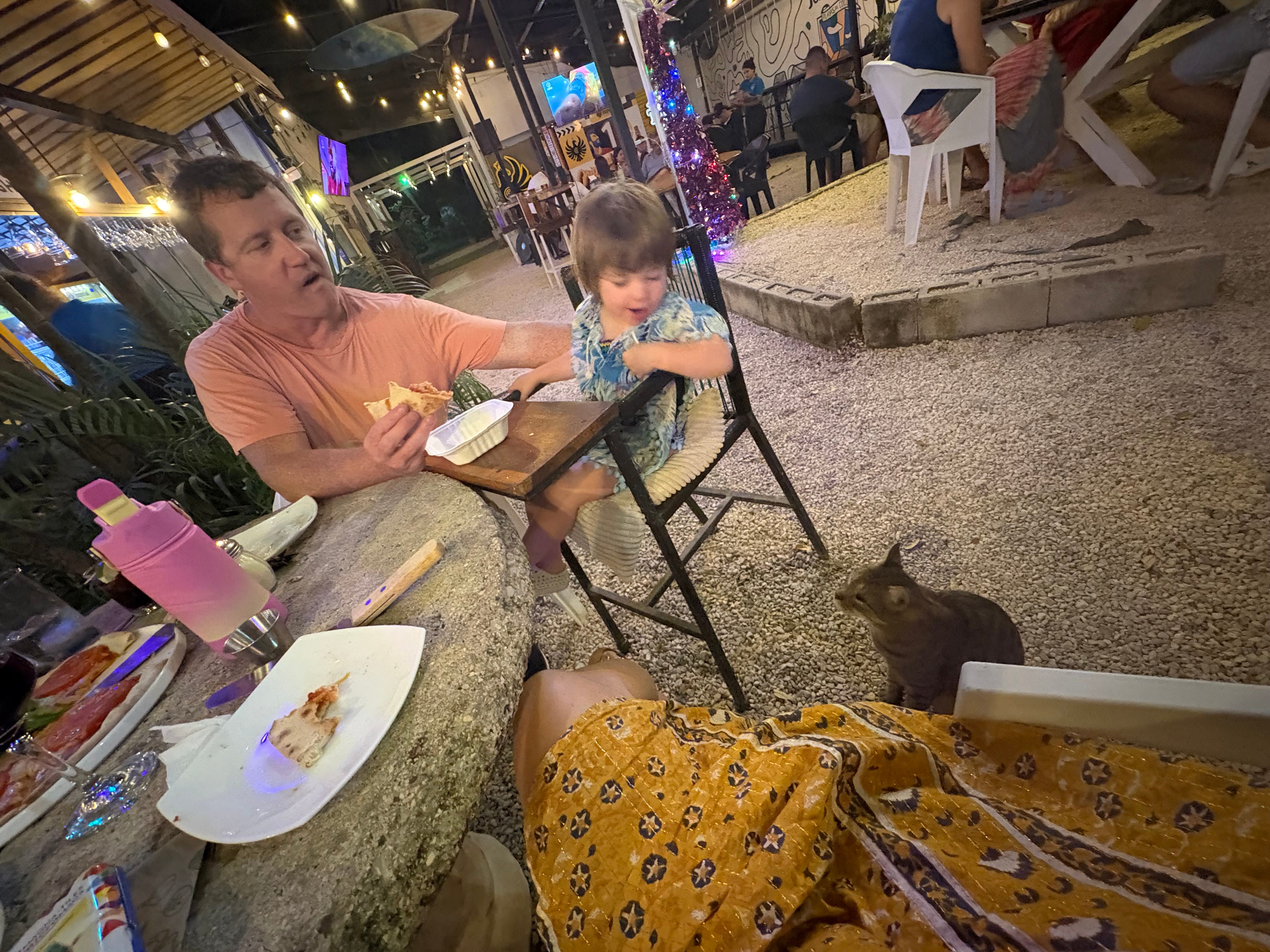
In Monteverde, Costa Rica’s “Cloud Forest” we slow down even more. I get stomach sick, and it’s so cold, we warm ourselves over espresso, hot chocolates, warm pastas, soup. Six thousand feet above sea level, the clouds smudge the sky.
At home, we celebrate Christmas with my mom, dad, and sister who have flown in, but the chill of the mountains follows us. Everyone gets my stomach flu, and the holiday is spent horizontal for most. Aoife insists that the Grinch and Max, “not Santa” come to bring toys, and we play Thurl Ravenscroft’s “You’re a Mean One, Mr. Grinch” on repeat.
Before the New Year, T travels home, and we travel to Puerto Viejo de Talamanca without him. It’s the first place I visited in Costa Rica—just three months before Covid hit, and while more developed than I remember, the visit confirms it is my favorite part of the country. Lush and green with heavy Caribbean influences, there is reggae music flowing and green, red, and yellow everywhere. Here, we watch surfers take on monster waves, spot a three-toed sloth in the wild, point out toucans flying in twos above our resort’s pool, take tuktuks to dinner and back. On our final day in town, sand or metal or glass kicks up from a scooter into my eyes, and my mom and I ride in a tourist van of fellow resort goers to the local clinic. In incredible pain, the doctor confirms: I have a scratched cornea. A vertical line to the left of my pupil. From a bug he insists, despite my tale—the line, he says, too perfect. He puts an anesthetic and antibiotic in my eye, covers it with a patch, and tells me to not do anything wild, that for the next 12 hours I will only see in 2D. When I get back to our suite, Aoife exclaims, “Mama, sticker!” Then she sits with me on our bed and asks over and over, “Mama, what happened?”
For once, it seems, there is no choice but look less closely, to let things spot and blur.
<><><>
Friends of Mother Of,
Thank you for being here with me through this year, and the last two years.
Sometimes I feel like my writing is going nowhere, so I appreciate all the reads, “hearts,” restacks, comments, and personal notes on what I share in this little corner of the web.
All health, happiness, and goodness,
S