“Last-Minute Stocking Stuffers,” “A Jewelry Collector on the Nicest Fine Jewelry Under $500,” “What West Village Girls Want for Christmas.” December is filled with guides that tell us what love should cost, what desire should feel like, what fits in a hand or in a stocking or under a Ralph Lauren tree.
In the spirit of Christmas and desire and accumulation, I am thinking a little bit about catalog, list as form.
At the time I worked at The Atlantic, I learned one of the most popular articles ever read was a list: “Every Celebrity Eminem Has Ever Dissed.”
Christina Aguilera.
Pamela Anderson.
Casey Anthony.
George W. Bush.
The list is long.
Of the list, Lucy K Shaw recently wrote in Zona Motel, “It’s a technique I use sometimes when I’m not sure how to get going.”
Lucy later losing her form in form itself—when she reaches line item #33, she writes, “I love being a shape in a wetsuit.”
I think of the list as shape or shape giving.
The list as
Long and
Serpentine and
Contained.
The list making a spine of the page, which only makes sense. Before it became an industrialized tool of inventory for the British empire—a thing that tallied, totaled, ranked, and claimed, the Old English word liste simply meant strip or band or edge.
Before it counted, the “list” simply ran.
In late summer of this year, I took a workshop on writing essay collections with Alexander Chee, and he recommended ideating essay topics using list as scaffolding. He recommended beginning with a list titled boldly “25 Things You Don’t Know About Me.” One of the items on that list, Chee suggested, could serve as a writerly jumping off point or launchpad or springboard. The fact that you surfed at Cocles Beach or met Kurt Cobain the subject or start or very first sentence of your essay.
So in that spirit—and not the holiday’s, here is my anti-Christmas Christmas List: 25 Things You Don’t Know About Me.
I see the calendar in an ellipse with December below the 3 o’clock and January above the 4 o’clock.
The Carpenters, who grew up in New Haven, were rumored to have recorded music in the very first house I lived in as a child.
My favorite Christmas tradition as a child was going to Polish church and feeding the porcelain angel coins. With each nickel placed into her slot, her head would bob.
When I get better, or when I publish my first book—whichever comes first, if either ever comes, I will get two lines from “Ariel” tattooed on the left side of my upper back—”I am the arrow/The dew that flies,” having been the arrow and also—for too long—the dew.
My fondest memories are of my paternal grandmother. How she asked where us “girls” were “gallivanting”—slipping us money for our adventures. How she would get her favorite candy—black licorice—stuck in her teeth. I remember oval-shaped nails peeling the husks of pomegranate to loosen their jewels at our kitchen island, and at our kitchen island, having her fake pearls eaten by my sister’s hamster. I remember her dizzy spells and how she never drove. How she stopped driving in middle age, like me.
My mom’s father got sick at 29 with rheumatoid arthritis; my mother got sick at 29 with rheumatoid arthritis. I, too, got sick at 29. While I don’t have RA, I can’t say my stomach issues are unrelated. In Native American families, autoimmune disease travels through bloodlines at higher rates, arriving more often than it should.
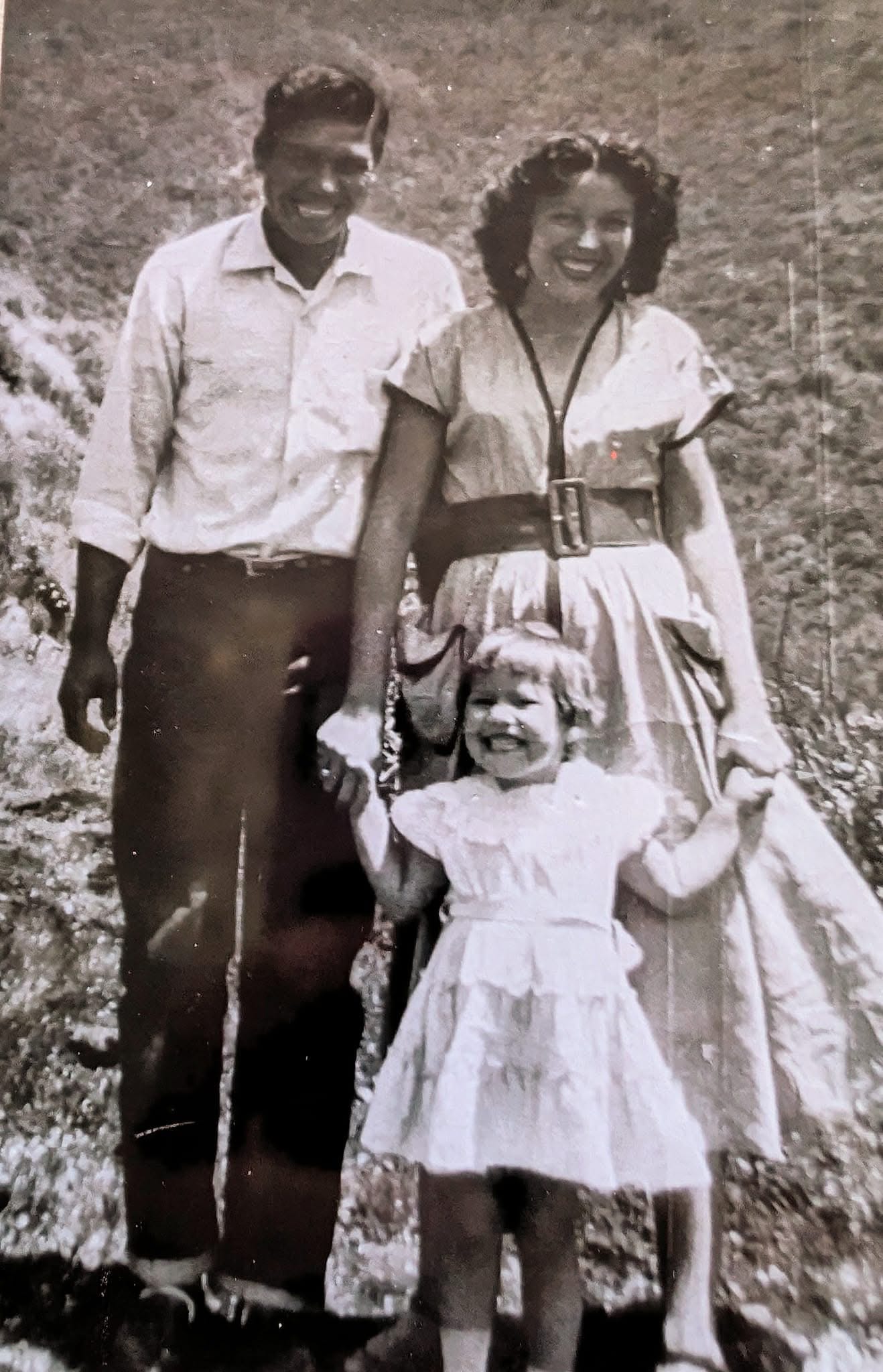
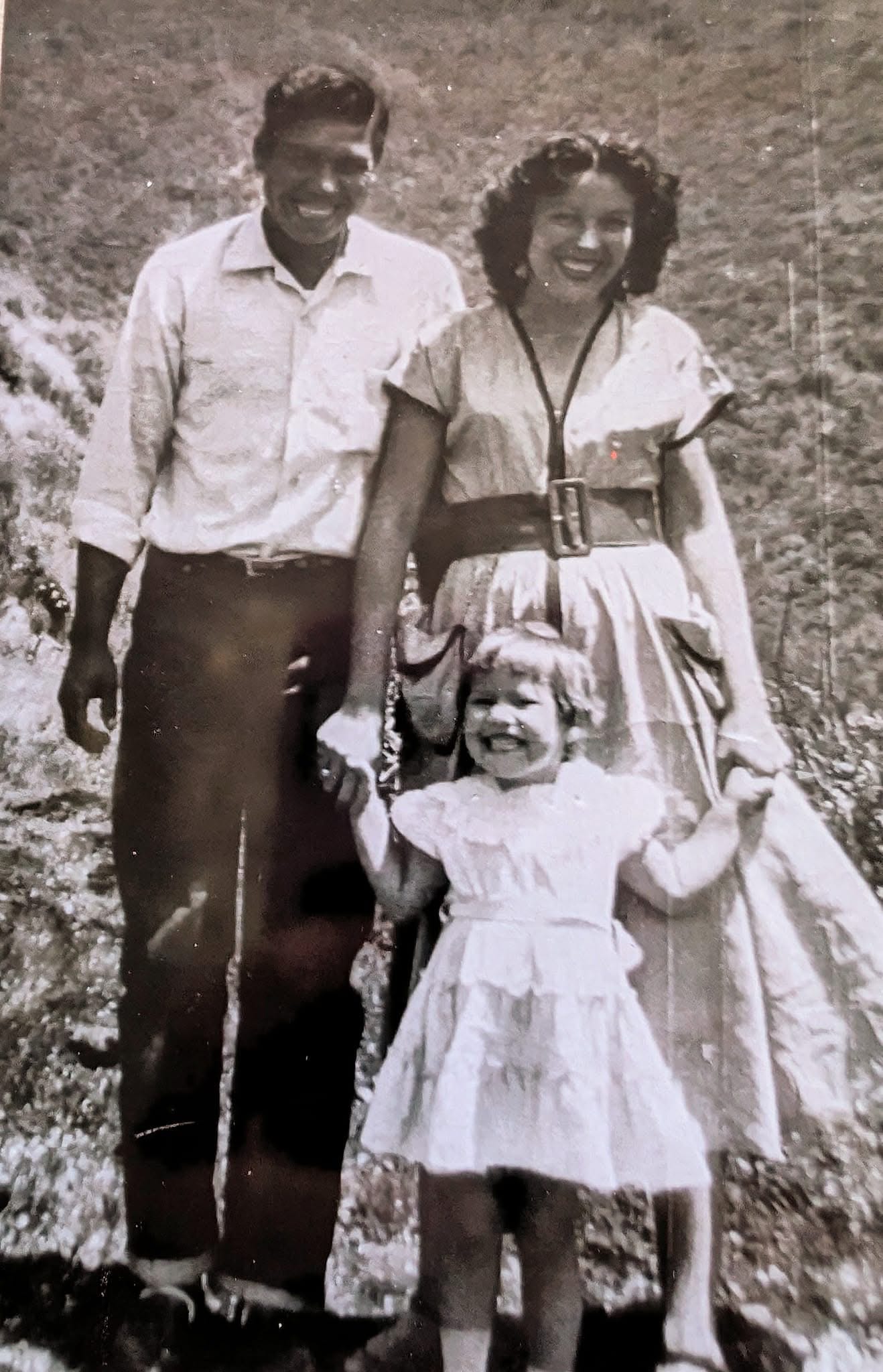
Early in her life, my mom moved around the country with her parents who worked—at times—as migrant farmworkers. This is an often-overlooked part of 1950s labor history and is frequently attributed to limited economic development and land restrictions on reservations and among tribal nations. My mom’s young family moved, like other indigenous families, from town to town, from season to season. While the Dawes Act allotted my family land in Hughes County, Oklahoma, they, like many, never stepped foot on it—instead farming other people’s land in Oklahoma, in Amarillo, Texas, in Bakersfield, California. My mom remembers being in the fields with her mother. She remembers pillowcases of cotton. She remembers one time living next to a large white family with many kids. She remembers a peach tree from which peaches fell.
My dad’s parents worked at the Peter Paul factory—later bought by Hershey’s. My grandmother sorted Mounds and Almond Joys. My grandfather was the factory’s electrical foreman. After her shift, my grandmother would bring the misshaped candies she collected—that couldn’t be sold—home as treats.
Last year, when getting a gastric emptying study, I had what science would call an auditory hallucination, but I am convinced it wasn’t a hallucination at all. I believe the veil slipped. I was at Columbus’ St. Francis Hospital on the second or third floor. I ate my radioactive eggs and toast, pressed my stomach against the machine for an image, then was escorted down two empty halls to an empty room with just a handful of chairs. As I was working, I heard people talking. The conversation was too faint to decipher, but loud enough to sound like it was coming from a nearby TV. There was no TV in the room, only a window. I went to the window, but there were no people. I moved through the room with no TV—from the window with no people to the door, and opened it. When I did, I found white walls, gleaming floors, and silence.
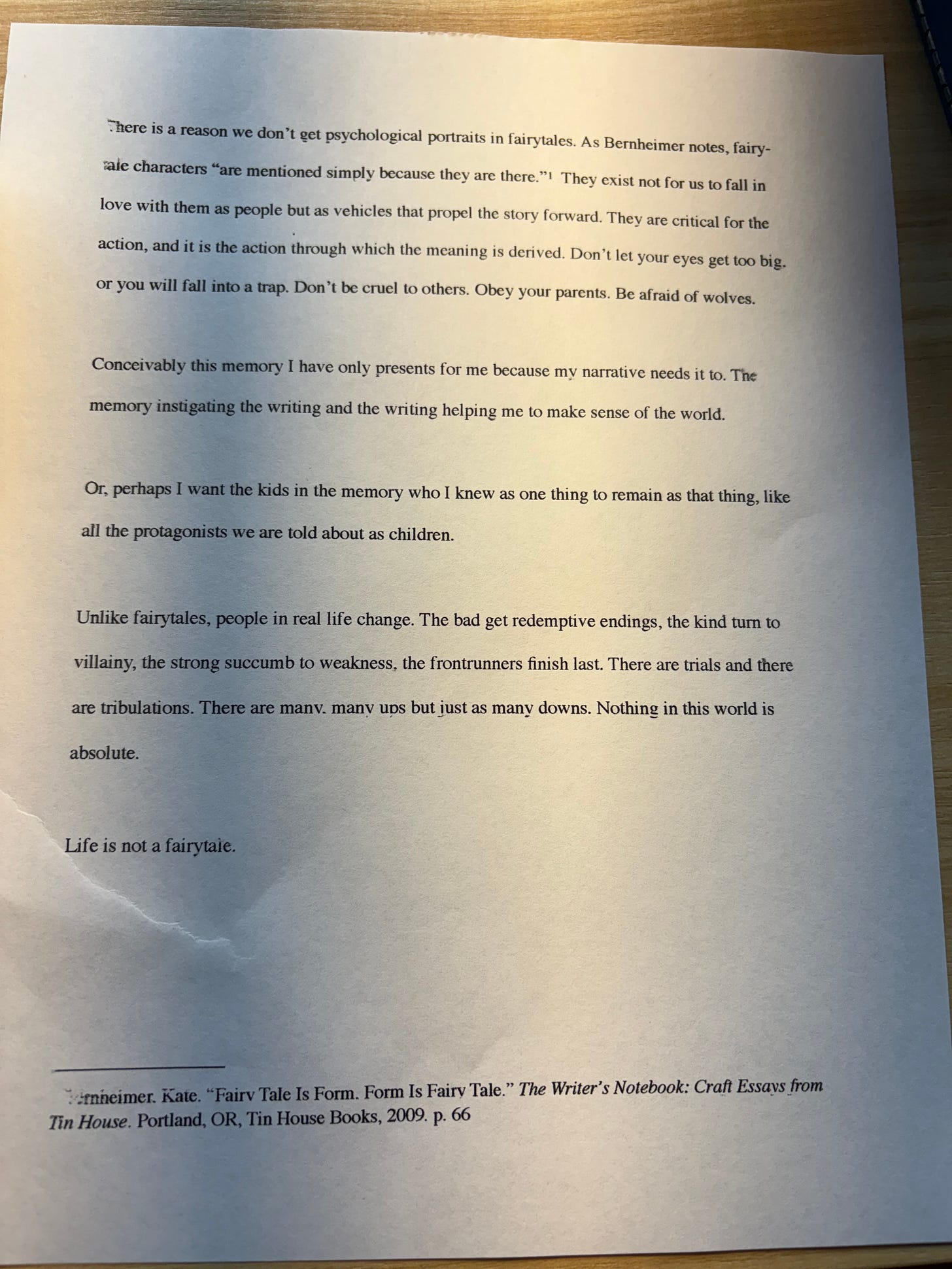
A high school friend of mine died when I first got sick, and I wrote a long essay about illness and ambiguous loss, the hero’s journey, fairy tale, heredity, and memory stemming from a single memory I have of him and an ordinary hug on an ordinary day in an ordinary high school gym. It’s the centerpiece of an essay collection that was a finalist for a prize and has never been published, and it’s my favorite piece. For the plainness of the unsick girl. For the plainness of the undead boy. For the plainness of that gym and that time and that memory. In that essay, I talk about my one and only incubus attack the week I wanted to kill myself. I swore someone pushed me back into my body.
Although I have only had one incubus attack, I have directed lucid dreaming (I can choose dreams I enter) and spatial dream mapping (my dreams are organized as recurring places I move through). In my dream world, hobbits live under my hometown’s golf course and country club, and in Boston there is an underground nightclub for vampires. At morning’s end, the vampires push their chests to their sky and are sucked up into the clouds like an image from rapture.
In high school, I weighed only 110 lbs., and at 110 lbs., I was approached by a model scout in a shopping mall.
In college, I dyed my hair blonde because “if Plath could do it, I could, too.”
In my 20s I volunteered at hospices across San Francisco. My first hospice patient was Martha at Coming Home hospice. Martha came from a well-established Japanese family in the city—her family having run one of San Francisco’s first Japanese newspapers. Her nephew visited her the most. He was a lawyer or banker and worked downtown, and our paths crossed often between sittings. He was her favorite, but her other nephew, a famous sportswriter at the time for The Mercury News, also came. On Mother’s Day, I brought Martha a huge bouquet of flowers even though she wasn’t a mother. On Mother’s Day, she told me then that year I would become a mother, even though I was 22 and not dating. When she died, I was crushed. At her wake, her family told me I gave her so much joy in her final weeks. In her final weeks, we didn’t talk about life or death, success, failures, fulfillment or regrets—we gossiped. My second hospice patient Hope was a single woman with a pixie cut in her early 80s. She had distant family in Utah and this distant family was concerned she was going to give all that she owned—all that was to her name (which I gathered might be a lot)—to two men, a couple that lived next to her for years in the Castro. When I met her nephew, I skirted around him in the staircase, uncomfortable. From what I gathered Hope despised her family but loved her neighbors who brought her flowers and also Coca-Cola from the glass bottle and burgers and fries. I bought Coca-Cola and burgers every Saturday on Divisadero until her final weeks. As part of the hospice program, volunteers were also asked to sit vigil, when people were in their final hours—actively dying. I sat only once, in the Inner Richmond, on a Friday night. I remember the patient couldn’t talk and her throat was gurgling and her eyes would open at random. Against her dark skin, they were swirls of white and blue, a Milky Way, distant and numinous. She was in her 90s, maybe close to 100. In my memory, the room smelled rich like velvet and mahogany and Billie Holiday was playing. I remember my one job for the four or five or six hours I sat vigil was to hold her hand and restart the disc when it ended. “She liked Billie Holiday,” the nurse explained—using the past tense. Every day before I saw Martha, I would buy pink peonies at a flower shop.
When Aoife was little, I’d sing to her nonsense lullabies to the tune of “Little Bunny Foo Foo” and sad hymns or almost-hymns like Leonard Cohen’s “Hallelujah” and “Amazing Grace” and Billie Holiday, which I guess I had heard a long time ago, in a room that smelled rich like velvet and mahogany.
Now, when I sing to Aoife, she says, “No, Mama!” “Mama, Stop!”
Now, she sings by herself.
She sings “Let It Go.”
She sings “We Don’t Talk About Bruno.”
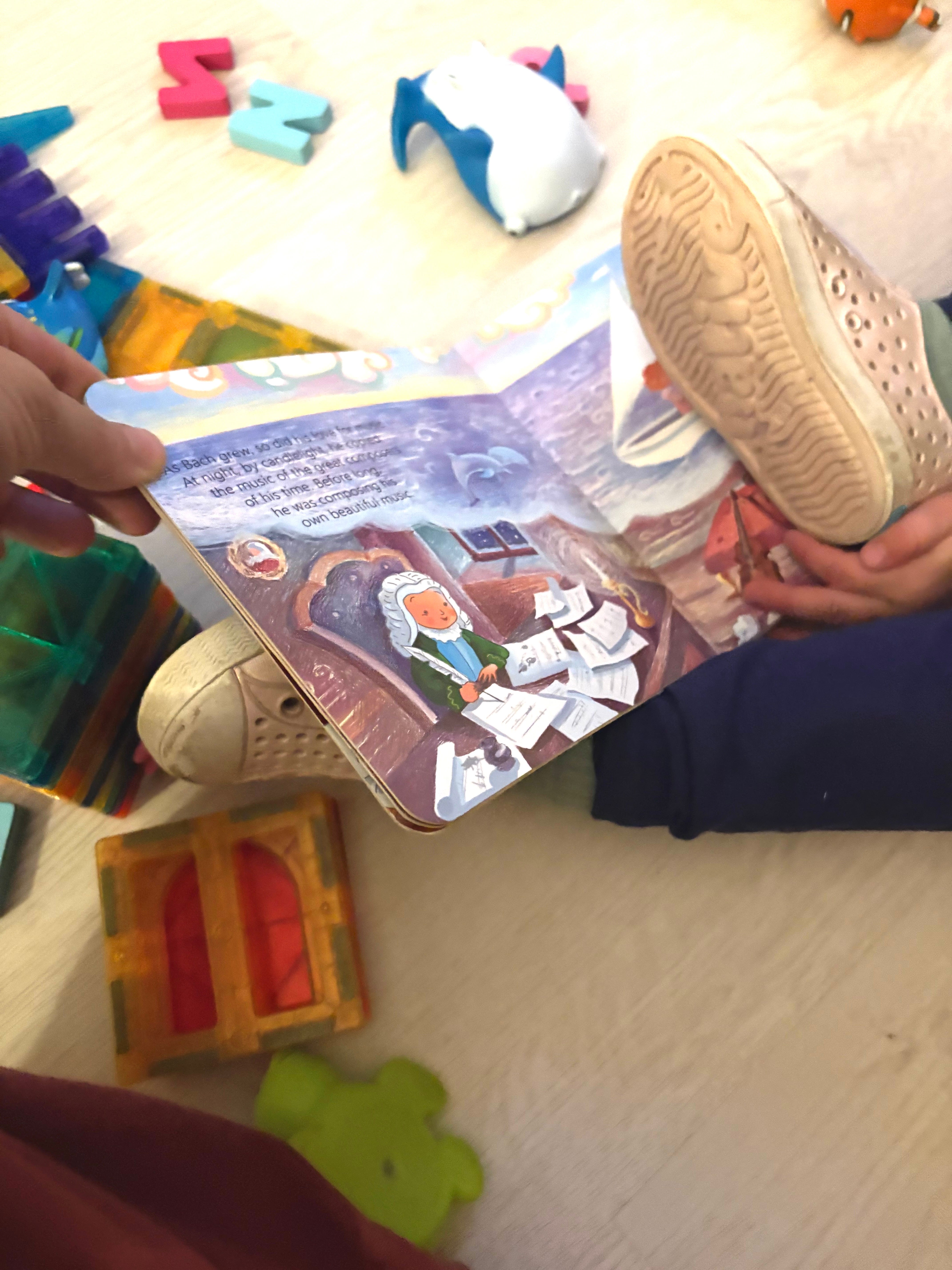
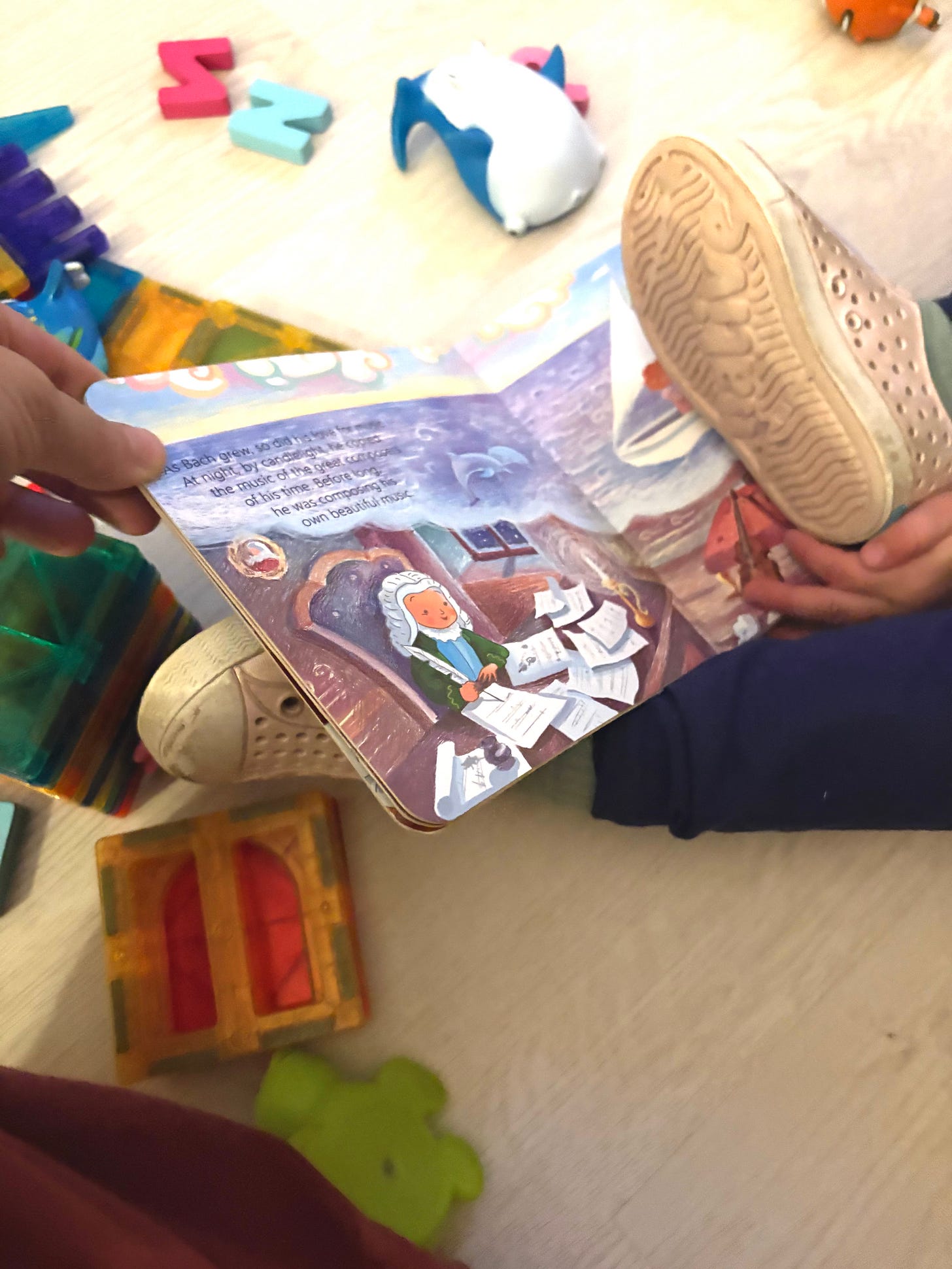
She hums to Jam Jam Books’ My First Bach, My First Beethoven, My First Carnival of the Animals, swaying to the waltz of the elephant.
“Tar!” she shouts when she sees a guitar on the page
“Piano!” she squeals in delight.
She points at Bach, scribbling music notations with a feathered pen and says, “Mama working!”
Like items on a list, one childhood milestone coming after another—a way of moving.
This year, mid-year, we moved again—this time to Costa Rica, and then we moved through.
Through September.
Through October.
Through November.
Through December.
The months a list themselves.
This list—no longer the list it was.
As I write this, life is moving differently, too.
Work has slowed and I am feeling a little like an ant left wondering where all the leaves I was made to carry, need carrying, are for me to carry, are.
Conditioned by capitalism to produce, the not-producing making me sad.
I post to LinkedIn, then feel embarrassed by my desperation.
When I went onto the platform, I imagined the people and posts to be like sirens—promising opportunity and praise, and me somehow like Odysseus, unable to resist joining them on their rock.
But then I read.
I read one post,
And then another,
And another.
“There was a time I thought my future was already written.”
“Being bold in B2B marketing can seem risky, but there’s something far more dangerous…”
“I’m going out on a limb to talk about attention and creativity and reciprocal inspiration.”
Unlike Odysseus, I don’t feel compelled to tie myself to a mast with ropes, funnel beeswax into my ears.
I think, instead, of The Subtext article by Andrew Boulton, a copywriter in Nottingham.
“How to survive LinkedIn” is also a list.
“Lower your tolerance for good stories told by bad storytellers. Fascinating things happen to tedious people all the time.”
“Believe the people who try the least to be believed. (This is also true for proper life.)”
“Don’t kid yourself that this is a modern illness.”
I’ve since decided I am moving away from pools that reflect my own face, this modern illness.
Right now, I am only thinking of American money and consumerism and attainment and Christmas lists indirectly, which is to say I’ve been thinking of their effect on the place I am living.
Of the women on the highways of Costa Rica with babies on their hips, selling plantain chips near the toll booths.
Of the caretakers from Nicaragua.
Of the refugees from Venezuela.
Of the “Christmas party” at our complex in San José, and my confusion about where our forty dollars for the party went.
The food: cash-only.
Decorations: one lone tree
A few men and women in bulbous Santa and snowmen outfits marching through the streets.
A snow-making truck idling among the palm trees.

My confusion lasting until the bags appeared:
Gifts for the guards,
Gifts for the gardeners,
Basic necessities like canned corn and garbanzo beans,
Toys for their children,
Tickets to the food truck for the families, which they would otherwise not afford.
I started contorting this list thinking eventually I’d get to very specific. things that filled me this year:
@blacklavendarmilk memes
@hypotheticalarrangements collages
Brooke DiDonato’s photographs
The children’s books of writer Julia Donaldson
The energy of Tunde Oyeneyin,
But in writing I realized the question is not what filleth your cup.
The question is not what is in your cup.
The question is who gets the cups and to fill them.
The question is why do only some of us have cups anyway.
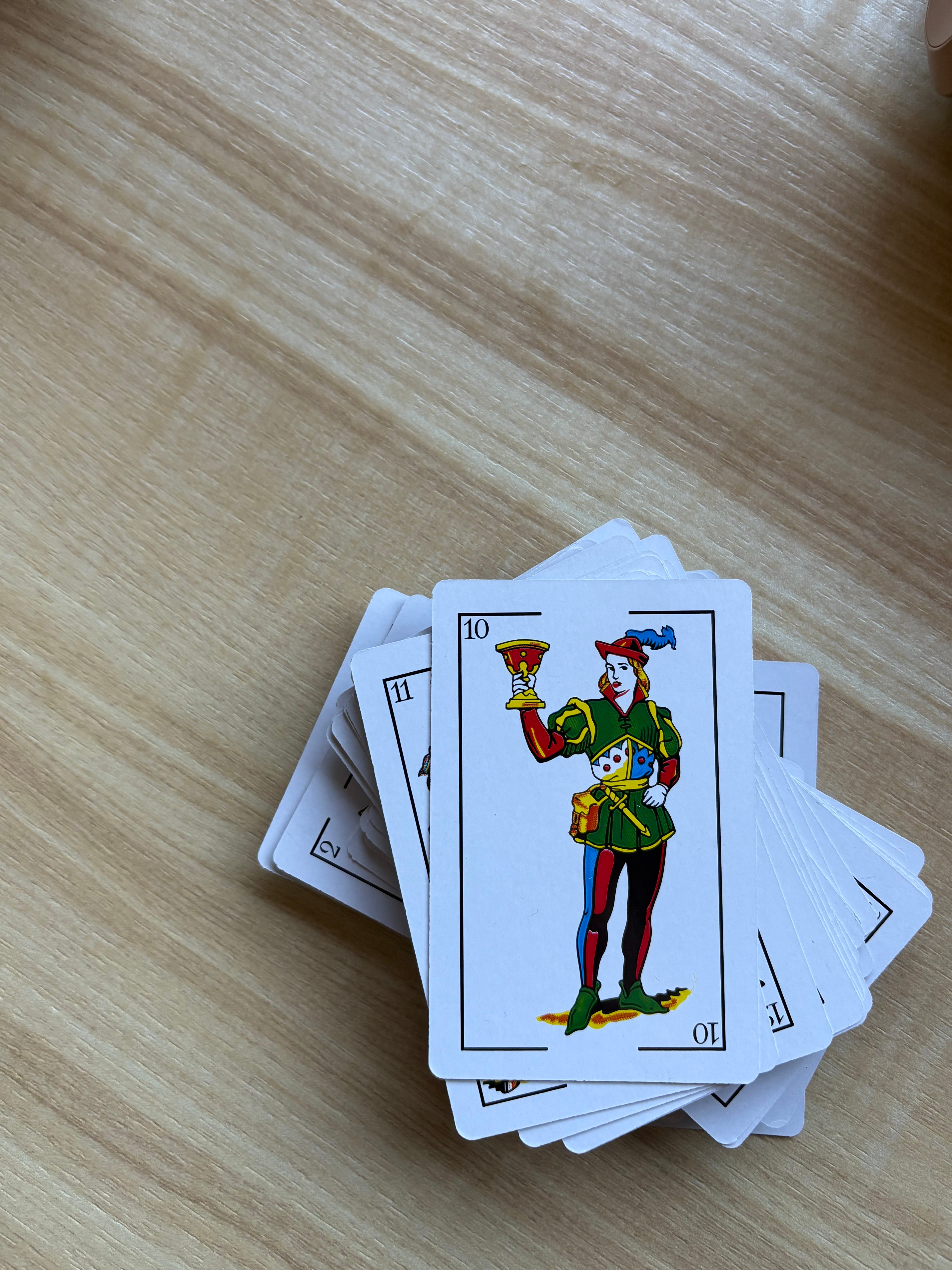
In the Spanish playing card deck, there are cups, or copas.
During our time in Columbus, M taught us Chinchón, a kind of rummy played in Argentina.
Two weeks ago I ordered a set of Spanish playing cards, a little nostalgic for the time we played around our kitchen table in the thick, buttery heat of Georgia summer, a kitchen table which is now in D’s home, a table she has photographed and sent to us—her family gathered around a cake, smiling.
In San José, D is teaching us something about tables.
In Columbus, M taught us the suits, which might not be so different.
M taught us when it was our turn, you draw.
She taught us that we could close the round only once our unmatched cards total ten or less.
She taught us that to win, you had to have not more, but fewer.
She taught us that we must discard one card before picking up another.
Nothing added without something released.
There was a lesson there about restraint.
There was a lesson there about economy.
There was also almost certainly a lesson there about order.
Each rule being specific, each term falling out of another.
When packaged together, the conditions, too, a list.
When the small box arrived, and Aoife saw the deck, she shouted in glee: “Cards, Mama!” “Mama, open!”
I told her they were special cards and only Mommy could play— remembering her blue-bearded in Key, having eaten my tarot as a baby, but she insisted, and so around our ottoman and cards we kneeled.
I peeled the cellophane.
I opened the tab, slid the glossy cards out.
Flipping the first over, I asked her what it depicted and how many.
We went through every number of every suit:
Uno,
Dos,
Tres,
Cuatro,
Cinco,
Seis.
Bastos,
Espadas,
Oros,
And copas—cups.
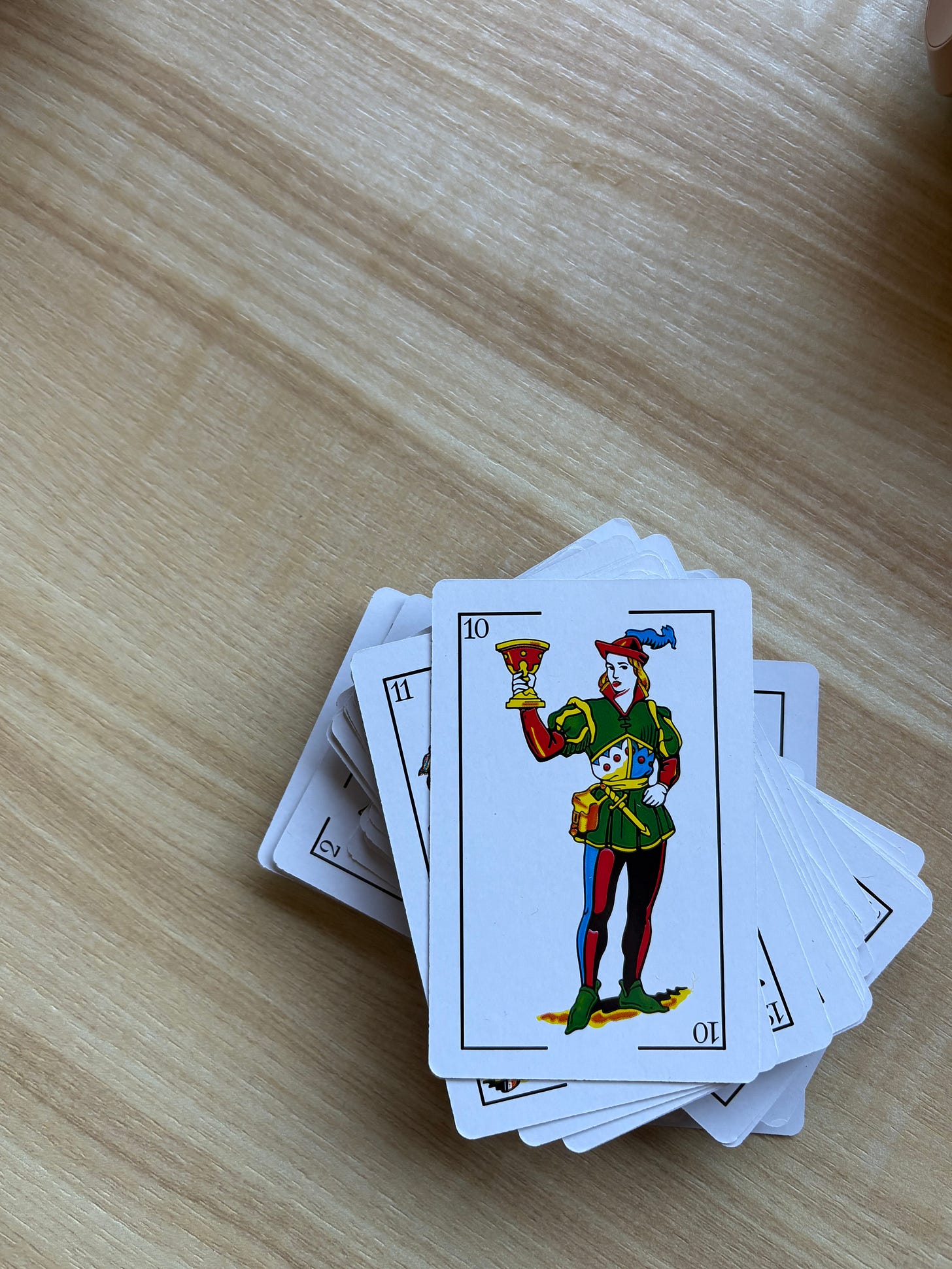
Cup comes from the Latin cūpa, meaning tub, cask, barrel,
and the Greek kýpellon, meaning goblet,
and the Sanskrit kūpa-, meaning hollow.
I am lucky to have a cup to fill this year and every year prior, that I see it as a soft hollow that needs tending—not stuffing.
And I hope that what I’m filling mine with—how I am tending to it—is right.
Art as attention.
Writing in service of living, of life.
Which can be beauty.
Or truth.
And maybe a little change.
Aoife’s finger charged in the air, pointing to a brown-black scorpion on the floor of a hotel room in Cañas, saying Bad Bug! Big Bug! Bad Bee! Me, peering over my phone, to see, shriek.
The sting of rose water on a freshly misted face.
The face of the sun setting in Jacó, rimming the clouds in pink, and the old surfer from Coco Beach sitting in his red camping chair, watching. The sand so soft, clouds, waves so flat, Aoife looks like she’s walking on water.
The small, intricate waves of pizzelles at Christmas, each lightly browned at their edges, some overly swollen and soft, some thin and brittle, the taste of anise.
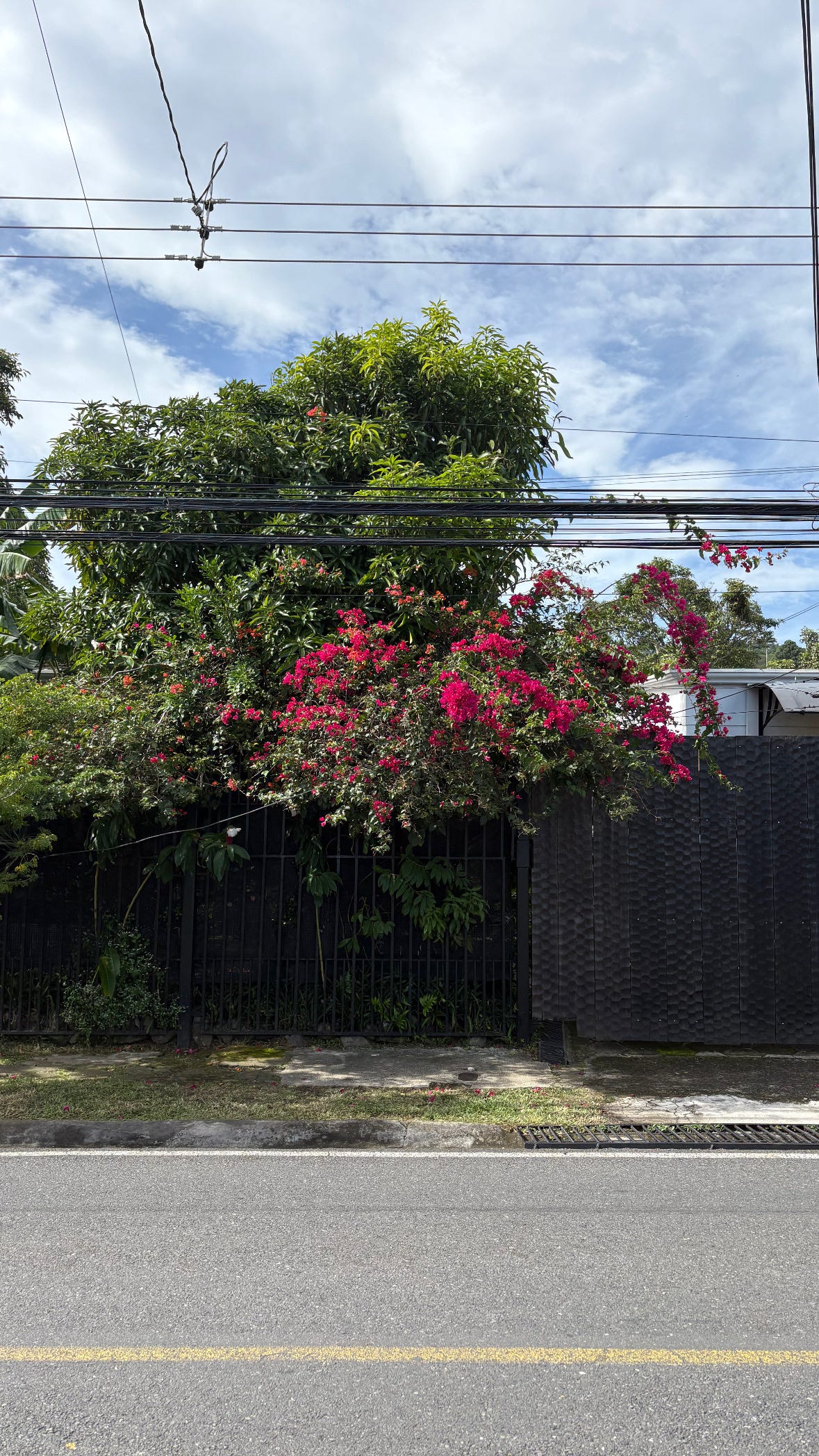
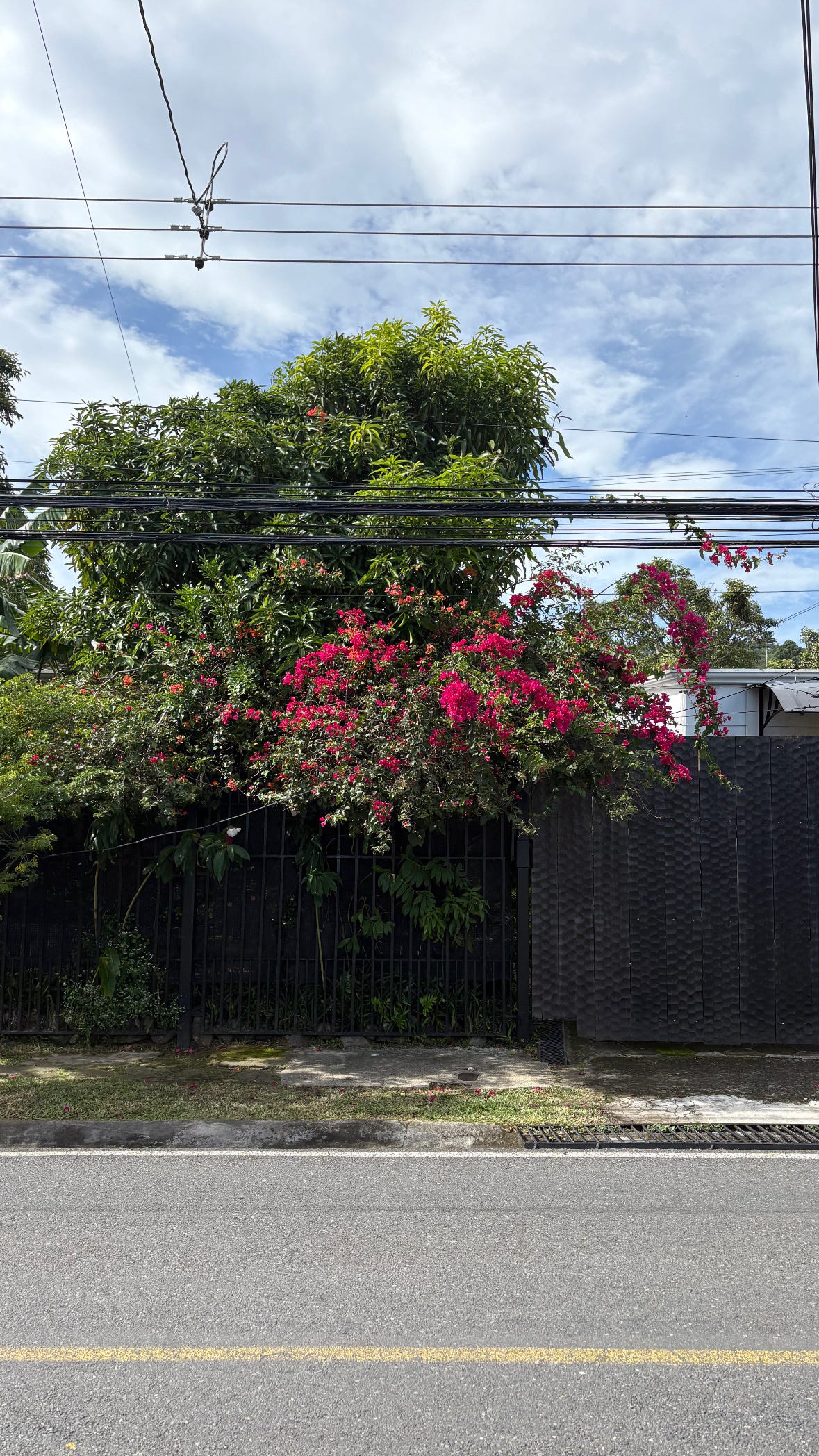
Razor wire—thinning in places, slack and overgrown in others—and gates upon gates upon gates. Gates keeping the people outside out. Gates barring the viewer from the view: the wild grasses and the palms and the pink and fuchsia flowers, the tiny yellow-throated, yellow-bodied birds.
Four tiny children with tiny fingers, eating loaded cheese fries and hamburguesas flowering with butter lettuce in an unfamiliar complex, under a lone, sparsely decorated pine.
When we were done counting the cups, Aoife gathered the cards back into a pile—messy and imperfect, dog-eared and bent.
As I pulled the cards in, she said, “Again, Mama, again.”
Not asking for more.
Not asking for new, or different, or better.
Not trying to win.
Just asking to keep going.
And I realized this is what this list is meant to teach me: a devotion to continuation—not enumeration, ongoingness—not accumulation.
So I shuffled the cards, and dealt.
Not to finish.
But to begin.
Again.